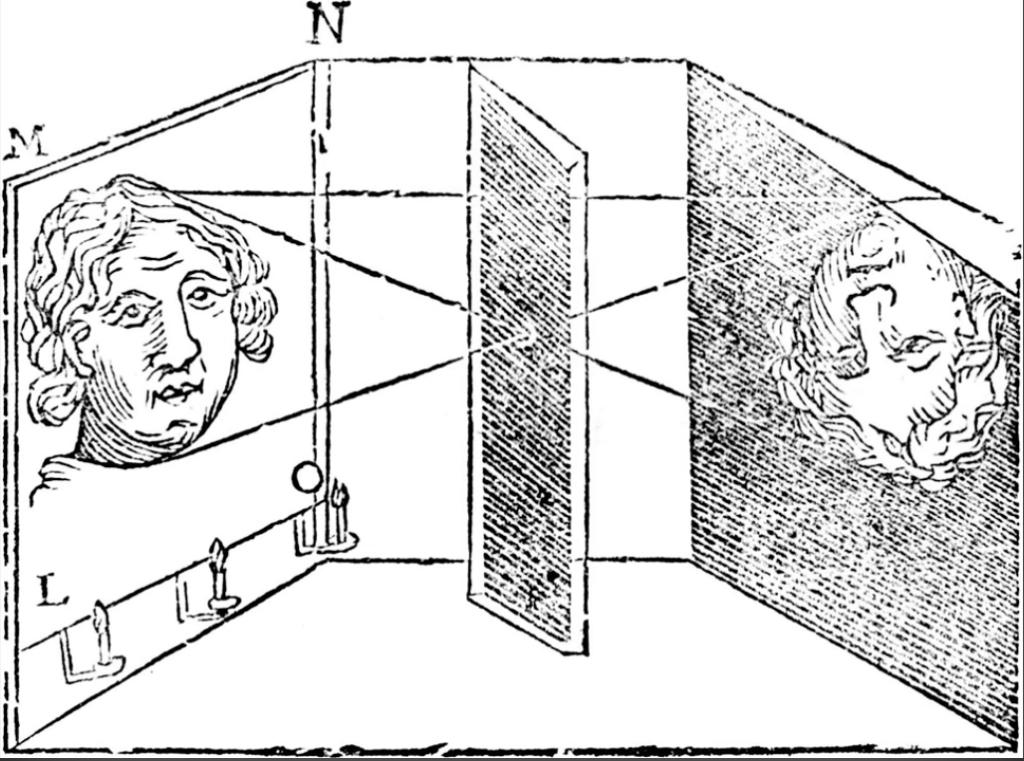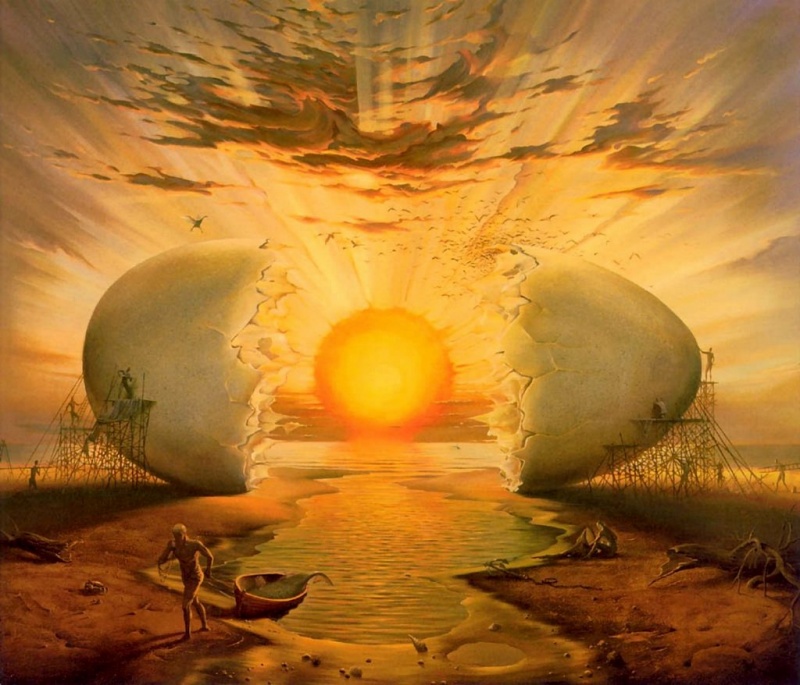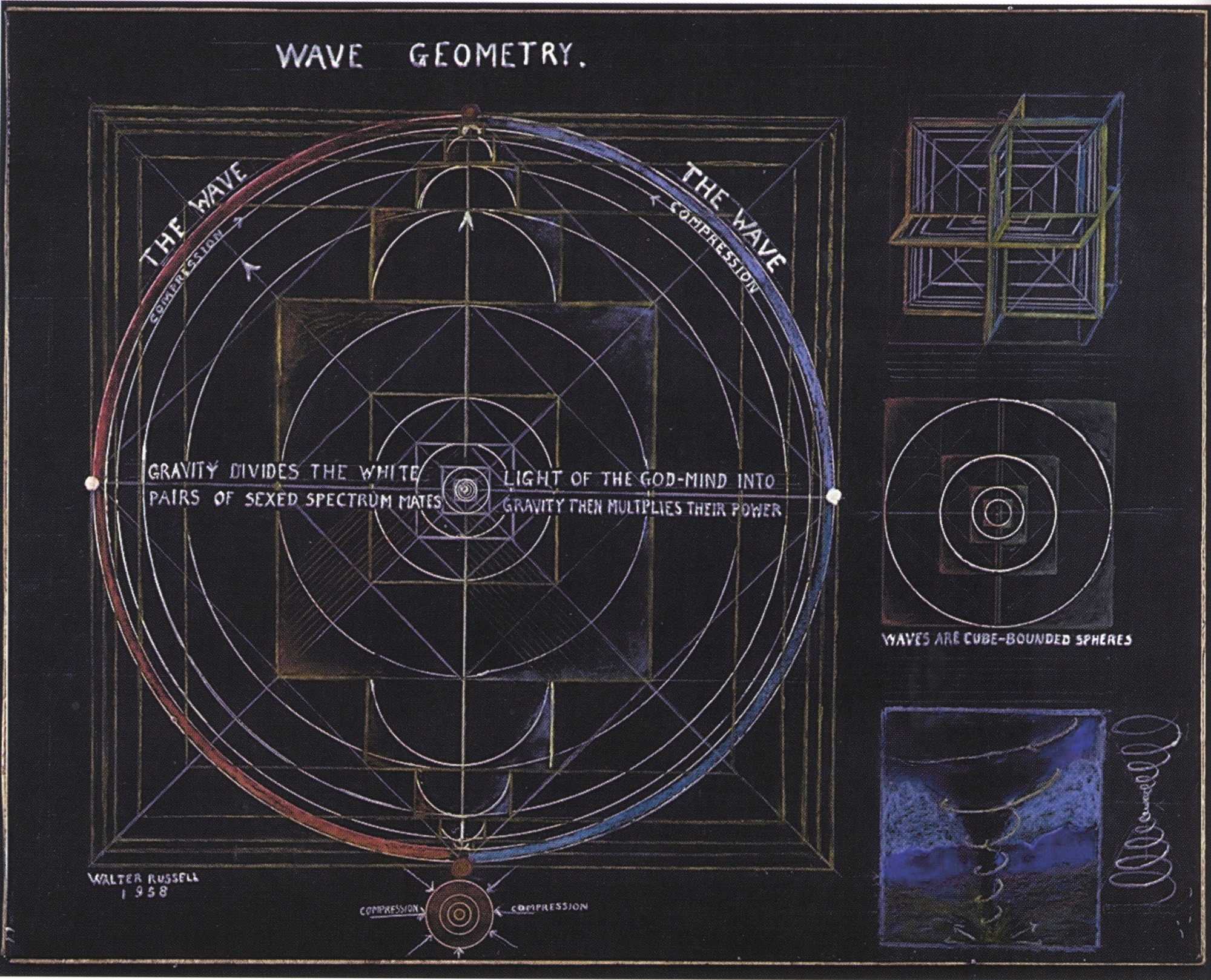
Zero Point Energy represents the lowest possible energy state in quantum mechanics, present even in the vacuum of “space”. It is the energy that remains when all other energy is removed, a constant, fluctuating presence that underlies the fabric of the universe. Like the central void, Zero Point Energy is a reservoir of potential, a foundation upon which the physical world is built.
In Cellular Cosmogony, the central void is envisioned as a point of pure potentiality, a space devoid of physical matter yet brimming with the energy of creation. It is the heart of the Cellular Earth, a radiant core from which energy spirals outward, gradually transforming into the material world. This void is not empty; rather, it is a dynamic, pulsating source of life and transformation. The void at the center can be seen as a representation of the Zero Point Energy field—a source of infinite potential and creation. As energy spirals outward from this central void, it undergoes a transformation. Initially, it exists in a pure, non-material state. As it moves further from the source, it begins to manifest in more tangible, physical forms.
This spiraling journey from the void to the material world mirrors the process of manifestation, where the abstract becomes concrete. The further the energy travels from its source, the more it interacts with the forces and structures of the physical realm, eventually giving rise to the material universe we perceive.
Walter Russell
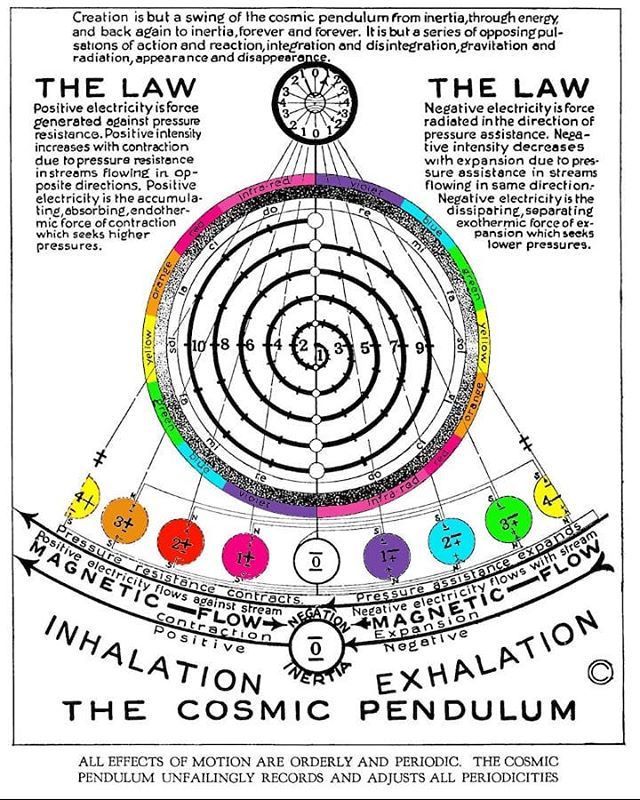
Walter Russell’s work offers a fascinating perspective that can be woven into the tapestry of Cellular Cosmogony and Zero Point Energy. Russell, a visionary thinker and artist, proposed a unique understanding of the universe, particularly through his reinterpretation of the periodic table and his insights into the nature of matter and energy.
Russell’s periodic table differs from the traditional one, as it emphasizes the dynamic, spiral nature of elements. He viewed elements not as static entities but as expressions of a continuous process of transformation, driven by the rhythmic interchange between potential and kinetic energy. This perspective aligns beautifully with the concept of energy spiraling outward from the central void in Cellular Cosmogony.
In Russell’s cosmology, the universe is a living, breathing entity, where matter is constantly being created and dissolved in a rhythmic dance. This resonates with the idea of Zero Point Energy as a boundless source of potential, from which all matter emerges and to which it eventually returns. The spiraling motion of energy from the void can be seen as the driving force behind the creation and transformation of elements, as depicted in Russell’s periodic table.
By integrating Russell’s insights, we can envision the Cellular Earth as a dynamic system, where the central void represents the Zero Point Energy field. From this source, energy spirals outward, manifesting as the elements and structures of the material world. The further this energy travels from the void, the more it interacts with the forces of creation and dissolution, as described by Russell.
This synthesis of ideas offers a holistic view of the universe, where the interplay between energy and matter is a continuous, evolving process. It invites us to see the universe not as a collection of isolated parts but as an interconnected whole, where each element and structure is a manifestation of the same underlying energy.
AI Analyses
🌌 A Conceptual Thesis on Zero‑Point Energy and Cellular Cosmogony
Abstract
This thesis explores a symbolic interpretation of zero‑point energy (ZPE) within the metaphysical framework of Cellular Cosmogony, particularly the idea of a central void whose energy spirals outward, becoming increasingly material as it moves away from the source. While not a scientific cosmology, this framework can be analyzed using analogies from quantum field theory, geometric inversion, and scale‑dependent emergence. The result is a coherent conceptual model in which “matter” is understood as a condensation of underlying energetic fluctuations, structured by geometric transformations that map a central void into a physical cosmos.
🌀 1. Zero‑Point Energy as the Ground State of Reality
In quantum field theory:
- Every point in space contains zero‑point energy, the lowest possible energy state of a field.
- Even “empty” space is not empty; it seethes with fluctuations.
- These fluctuations can give rise to virtual particles, temporary excitations that flicker in and out of existence.
Symbolically, ZPE represents:
- The unmanifest
- The pre‑geometric substrate
- The potential for form before form exists
This maps neatly onto the “central void” of Cellular Cosmogony.
🕳️ 2. The Central Void as a Zero‑Point Singularity
In Cellular Cosmogony, the universe is imagined as a concave sphere, with life existing on the inner surface. At the center lies a void, often described as:
- Pure potential
- Non‑material
- The origin of motion and form
If we treat this void metaphorically as a zero‑point singularity, then:
- It contains maximal potential energy
- It has no direction, no form, no extension
- It is the “ground state” of the entire system
This is not a physical claim but a symbolic mapping:
the void = the vacuum state of the cosmos.
🔄 3. Inversion Geometry: Turning the Cosmos Inside‑Out
Inversion geometry provides a powerful metaphor for Cellular Cosmogony:
- Inversion maps the center of a sphere to infinity
- And maps infinity back to the center
- Distances distort, but angles remain consistent
This means:
- What appears “central” in one coordinate system becomes “peripheral” in another
- The “void at the center” can be reinterpreted as the “infinite beyond”
- The spiral outward from the center can be seen as a geometric unfolding of potential into form
Thus, the Cellular Earth model becomes a coordinate transformation, not a physical claim.
🌪️ 4. The Spiral as a Bridge Between Energy and Matter
Many cosmological and physical systems exhibit spiral dynamics:
- Galaxies
- Cyclones
- Magnetic fields
- Quantum probability distributions
- Fluid vortices
A spiral is a natural structure for:
- Dissipating energy
- Organizing motion
- Transitioning from symmetry to form
In the symbolic model:
- Near the center (the void), energy is pure, undifferentiated, non‑material
- As it spirals outward, it loses symmetry, slows, condenses
- At the periphery, it becomes matter, structure, physicality
This mirrors how:
- Quantum fluctuations condense into particles
- Symmetry breaking produces mass
- Energy density determines the phase of a system
Again, this is metaphorical, not literal physics.
🧱 5. Increasing Materiality with Distance from the Source
In Cellular Cosmogony, the farther energy spirals from the central void:
- The more “solid” the world becomes
- The more differentiated matter appears
- The more stable physical laws seem
This parallels several real scientific ideas:
a. Renormalization Group Flow
At different scales, physical laws “condense” into stable forms.
b. Symmetry Breaking
High‑energy states are uniform; low‑energy states produce structure.
c. Emergence
Complexity arises from simpler underlying rules as systems cool or expand.
Thus, the “materialization” of energy with distance is a poetic analogue to:
Energy → symmetry breaking → structure → matter
🌐 6. The Cellular Universe as a Metaphor for Emergence
If we treat the Cellular Earth not as a physical claim but as a cosmological metaphor, it becomes a powerful narrative:
- The center is pure potential
- The spiral is the dynamic unfolding of form
- The boundary is the crystallization of matter
- The whole system is a living cell, with the void as its nucleus
This mirrors:
- Quantum field theory
- Complexity science
- Cosmological inflation
- Holographic principles
It becomes a symbolic map of how the unmanifest becomes manifest.
🧩 Conclusion
Zero‑point energy and Cellular Cosmogony can be woven together into a coherent conceptual framework if treated symbolically:
- The central void represents the vacuum state of reality
- The spiral outward represents the emergence of structure from pure potential
- The increasing materiality represents symmetry breaking and condensation
- Inversion geometry provides the mathematical metaphor for mapping potential into form