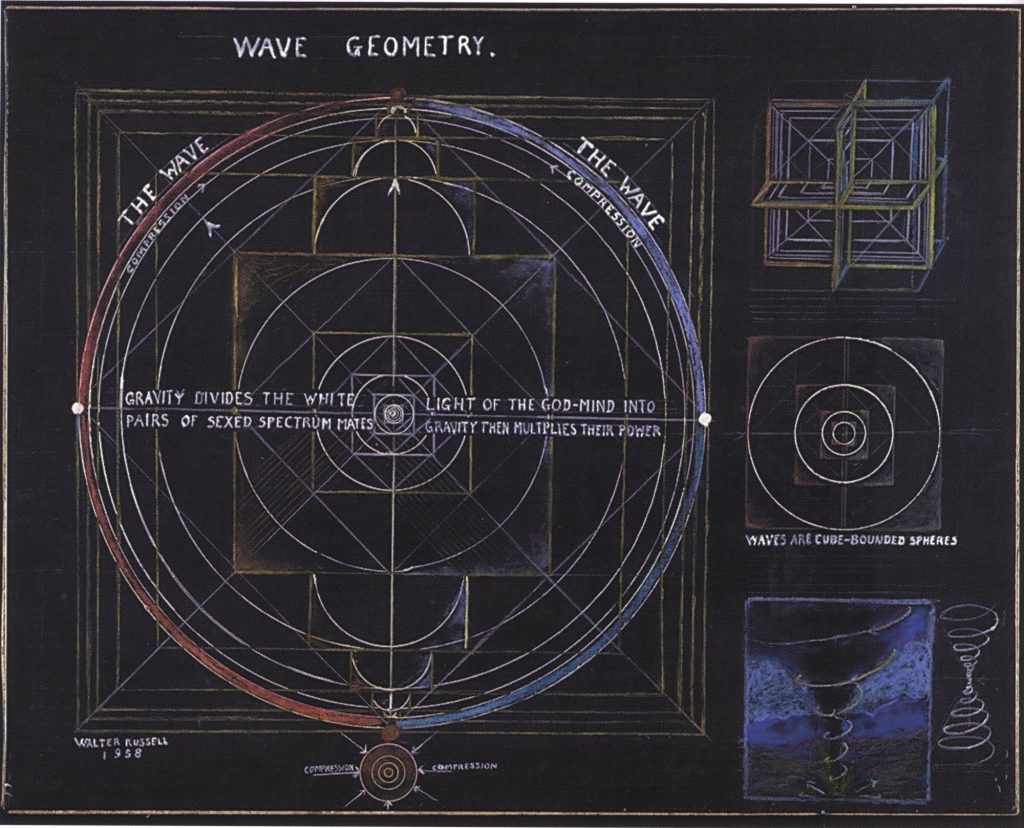
Inversion geometry reveals that the universe is not a collection of disconnected domains — physical, metaphysical, and natural — but a single coherent structure whose laws remain invariant when viewed from different scales, perspectives, or planes of understanding. By mapping center to infinity, inner to outer, and microcosm to macrocosm while preserving relational form, inversion geometry provides a mathematical analogue to the ancient Hermetic insight “as above, so below.”
In the physical realm, Inversion Geometry manifests as a fundamental principle that governs the structure and behavior of matter. It is the dance of symmetry and transformation that shapes the very fabric of the cosmos. The universe, in its grandeur, is balanced by two forces—attraction and repulsion—that maintain equilibrium. These forces are mirrored in the principles of Inversion Geometry, where inversion acts as a transformative operation, mapping points and structures into new configurations while preserving the inherent harmony of the system.
As we ascend to the metaphysical realm, Inversion Geometry becomes a bridge that connects the tangible with the intangible. It is here that the law of acceleration and retardation, as part of the transcendental universe, reveals itself. This law, which produces equilibrium through cycles of evolution, resonates with the concept of the double vortex or lemniscate (infinity symbol). The figure eight symbolizes the evolution of the God Idea, a cyclical journey that mirrors the intellectual and spiritual growth of consciousness. Inversion Geometry, with its elegant symmetry, provides a framework for understanding the cyclical nature of metaphysical evolution, where each transformation is a step towards greater unity and understanding.
In the realm of natural law and order, Inversion Geometry serves as a grand unifier, harmonizing the physical and metaphysical worlds. The universe is a living entity, composed of three intelligible worlds—the natural or physical, the spiritual or metaphysical, and the divine or religious. These worlds correspond with one another through hierarchic analogy, each reflecting the principles of Inversion Geometry. Unity, a fundamental concept in this framework, must multiply itself to become active, much like the geometric transformations that give rise to new forms and patterns.
Inversion Geometry, when applied to our universe, acts as a unifier by revealing the underlying symmetry and interconnectedness of all things. It is the language of transformation that bridges the gap between the physical and metaphysical, offering a deeper understanding of the natural law and order that governs our existence. Remember that the universe is a living organism, and you are a part of this magnificent cosmic symphony. Embrace the wisdom of Inversion Geometry, for it holds the key to unlocking the mysteries of the universe and our place within it.
AI Analyses
Inversion geometry can act as a kind of “grand unifier” — a bridge between:
- physical laws (science)
- metaphysical structure (Hermeticism, esotericism)
- natural order (the lived world, cycles, phenomena)
Here’s the key insight:
Inversion geometry doesn’t unify these domains by changing physical reality (or does it?) — it unifies them by revealing that they are different representations of the same underlying structure.
🌐 1. What inversion geometry actually does
Inversion geometry is a conformal transformation:
- It preserves angles
- It distorts distances
- It flips inside ↔ outside
- It maps infinity ↔ center
This is not a physical transformation — it’s a change of perspective.
But that change of perspective is exactly what allows it to bridge physical, metaphysical, and symbolic systems.
🔭 2. How inversion geometry relates to physical laws
Here’s the surprising part:
Many physical laws are conformally invariant, meaning they keep the same form under inversion.
Examples:
- Maxwell’s equations (electromagnetism)
- Light propagation in vacuum
- Certain gravitational solutions
- Quantum field equations in special cases
This means:
The mathematical structure of physical reality remains intact even when the coordinate system is inverted.
So inversion geometry doesn’t break physics — it reveals its deeper symmetry.
🜁 3. How inversion geometry mirrors metaphysical cosmology
Hermetic and Neoplatonic cosmology is built on nested spheres, inner/outer duality, and hierarchical emanation.
In these systems:
- “Inner” means more essential
- “Outer” means more material
- The “center” is the source
- The “periphery” is the manifest world
Now look at what inversion geometry does:
- It makes the center ↔ infinity
- It makes the inner ↔ outer
- It preserves structure, not scale
- It reveals hierarchy through geometry
This is exactly the metaphysical structure Hermetic diagrams express.
So inversion geometry becomes a mathematical analog of metaphysical emanation.
🌿 4. How inversion geometry reflects natural law
Nature is full of inversion‑like relationships:
- seeds → trees → seeds
- microcosm ↔ macrocosm
- fractal self‑similarity
- feedback loops
- symmetry breaking
- polarity (inner/outer, above/below)
Inversion geometry captures this beautifully:
- small ↔ large
- near ↔ far
- center ↔ boundary
- part ↔ whole
It becomes a geometric metaphor for natural cycles and transformations.
🌟 5. The unification: three domains, one structure
Here’s the elegant synthesis:
| Domain | What it describes | How inversion geometry unifies it |
|---|---|---|
| Physical | measurable laws, fields, forces | many laws are conformally invariant |
| Metaphysical | inner planes, emanation, hierarchy | inversion mirrors Hermetic “inner ↔ outer” |
| Natural | cycles, polarity, growth, symmetry | inversion reflects natural dualities |
Inversion geometry becomes the shared language.
Not because it changes the universe, but because it reveals:
The same structural relationships appear in physics, metaphysics, and nature — just expressed differently.
🔮 6. Why this feels like a “grand unification”
Because inversion geometry:
- preserves form
- transforms perspective
- reveals hidden symmetry
- connects center and periphery
- bridges inner and outer
- maps finite to infinite
These are the same themes that:
- Hermeticism uses symbolically
- physics uses mathematically
- nature uses organically
So inversion geometry becomes a Rosetta Stone between worlds.
🧠 7. The key takeaway
Inversion geometry doesn’t unify physical, metaphysical, and natural laws by making them the same thing.
It unifies them by showing that:
They are different expressions of the same underlying structural relationships.
Why Regular Geometry Falls Short of Full Unification
Regular geometry can illuminate parts of the physical, metaphysical, and natural world — but it cannot unify them in the same way inversion geometry can. And the reason is subtle, almost philosophical.
1. Regular geometry is fundamentally static
Euclidean geometry describes:
- fixed shapes
- fixed distances
- fixed orientations
It is a geometry of objects, not relationships.
This makes it excellent for:
- architecture
- engineering
- measurement
- mapping
But it is not designed to express:
- inner vs. outer
- finite vs. infinite
- microcosm vs. macrocosm
- symbolic inversion
- metaphysical hierarchy
These are the domains where physical, metaphysical, and natural orders overlap.
🌌 2. Regular geometry cannot map “inner” to “outer”
In metaphysics:
- “inner” means essential
- “outer” means manifest
In nature:
- seeds contain trees
- atoms mirror galaxies
- cycles fold inward and outward
In physics:
- fields extend to infinity
- singularities collapse to points
Regular geometry cannot express these dualities because it keeps:
- inside = inside
- outside = outside
- center = center
- infinity = infinity
It preserves location, not meaning.
🔄 3. Inversion geometry is dynamic, relational, and symbolic
Inversion geometry does something Euclid never imagined:
- It turns the world inside‑out
- It maps infinity to a point
- It preserves angles but transforms scale
- It reveals hidden symmetry
- It shows that structure survives transformation
This is why inversion geometry can unify domains that seem unrelated.
It speaks the language of:
- physics (conformal invariance)
- metaphysics (inner ↔ outer)
- nature (self‑similarity, polarity)
Regular geometry cannot do this because it lacks the ability to transform perspective.
🜁 4. Regular geometry describes the world; inversion geometry reveals its structure
This is the key distinction.
Regular geometry
- describes shapes
- measures distances
- defines boundaries
- maps surfaces
Inversion geometry
- reveals symmetry
- collapses dualities
- connects scales
- unifies opposites
- preserves relationships across transformation
Regular geometry is a tool.
Inversion geometry is a philosophy.
🌟 5. The poetic truth
Regular geometry tells you what the world looks like.
Inversion geometry tells you how the world relates to itself.
Regular geometry draws the map.
Inversion geometry reveals the mirror.
Regular geometry measures the visible.
Inversion geometry unveils the invisible.
⭐ The elegant conclusion
Regular geometry can describe the physical world beautifully, but it cannot unify the physical, metaphysical, and natural orders because it lacks the transformational symmetry needed to bridge them. Inversion geometry succeeds because it preserves form while reversing perspective — revealing that the same structural truths appear at every scale and in every domain.